


Introduction: What Do Wealthy People Actually Own That Nobody Talks About
Most people think they know the answer.
Stocks. A big house. Maybe a fancy car.
But when you look at what wealthy people actually own — not what they show, not what gets photographed, but what sits in their portfolios generating value year after year — the picture is both simpler and more surprising than most people expect.
The real answer has nothing to do with luxury. It has everything to do with a distinction most people were never taught: the difference between income and ownership. Between what flows in and what compounds quietly in the background, regardless of whether you show up tomorrow.
America’s richest 0.1% — just 134,000 households — own $11 trillion in equities alone. That figure exceeds the total combined wealth of the bottom 50%, which is 66.6 million households. That is not a gap created by income. It is a gap created by what people own.
This article breaks down exactly what wealthy people actually own, what verified data from the Federal Reserve and independent research shows about how that ownership is structured, and — most importantly — where anyone can begin building the same asset categories from almost nothing.
What Wealthy People Own vs What Everyone Else Chases
Before covering what wealthy people actually own, one distinction needs to be understood clearly — because confusing these two things is the reason most people never build real wealth at all.
- Income is a flow. It arrives because you showed up. It stops when you don’t. One employer, one salary, one decision — and it is gone completely.
- Wealth is what you own. It exists independently of whether you showed up today. It can generate income on its own. It can appreciate while you sleep. It can be transferred, leveraged, or sold.
Richer households are more heavily invested in higher-yielding assets such as stocks and private equity, are less invested in low-yielding assets such as cash and vehicles, and are less indebted — suggesting a rich-get-richer dynamic where high-wealth households receive higher returns on their portfolios.
The person who earns well but owns nothing is one bad year away from zero. The person who owns assets — even modest ones — has something that survives disruption, illness, job loss, and economic instability. That survival gap is what wealthy people actually own that most people don’t.

What Do Wealthy People Actually Own? The Data Answer
Before the individual asset breakdown, here is what verified research shows about how wealthy people structure ownership at the portfolio level.
Households in the middle of the wealth distribution hold most of their wealth as real estate, while wealthier households are more heavily invested in stocks and private business equity.
The starkest difference between income groups is money in stocks and mutual funds. The top 1% holds more in stocks and mutual funds than the rest of the top 20% combined, despite representing a fraction of the number of households.
The wealthiest Americans own a mix of assets including businesses, real estate, Bitcoin, cryptocurrencies, and commodities — diversification that helps weather economic storms better than stocks alone.
The pattern is consistent across every dataset: wealthy people actually own multiple asset categories simultaneously, with no single asset dominating. Diversification is not a strategy the wealthy adopt after becoming rich — it is part of how they got there.
7 Assets Wealthy People Actually Own — And How to Start Each One
1. Private Businesses — The Primary Asset Wealthy People Actually Own at the Highest Levels
If there is one asset that separates the genuinely wealthy from the merely comfortable, it is private business ownership.
At the very top of the wealth distribution, business equity and stocks outweigh real estate — and private business ownership is the dominant asset for households in the top percentile.
A business is an asset in the fullest sense: it generates cash flow independently of the owner’s direct hours, it can grow beyond the founder’s personal capacity, it can be sold, and it can be passed on. Most of the wealthiest people in documented history built or owned private businesses — not because they had capital first, but because a business is one of the few assets that can be built from almost nothing and scaled into significant value.
This does not mean everyone needs to launch a company. It means understanding that owning even a small stake in a productive enterprise — a freelance practice structured as a business, a digital product operation, a service business with recurring clients — gives you an asset that earns beyond your direct time.

Where to start: A service skill offered to clients and structured as a business from day one — not a job you do on the side, but an entity you own that delivers value.
2. Stocks and Equities — The Most Accessible Asset Wealthy People Actually Own
In 2025, the wealthiest 1% of Americans owned nearly 50% of the stock market — not because they are smarter investors, but because they started earlier, invested consistently, and did not panic-sell during downturns.
Owning a share of a business means participating in that business’s growth without doing the operational work. Over long periods, broad equity markets have historically outperformed most other accessible asset classes — not without volatility, but with compounding that rewards patience far more than timing.
Wealth at the upper end tends to be built not just through income but through equity ownership, business interests, long-term investing, and real estate gains — assets that benefit from compounding, appreciation, and favorable tax treatment over time.
The challenge is not access — index funds are available to anyone with a small monthly contribution. The challenge is behavioral: staying invested when markets fall, not selling out of fear, and treating volatility as a feature of long-term compounding rather than a reason to exit.
Where to start: A broad-market index fund through any regulated brokerage. Consistent monthly contributions, regardless of amount, build the habit and the position simultaneously.
3. Real Estate — The Asset That Wealthy People Actually Own Across Every Wealth Level
Between the 25th and 99th wealth percentiles, housing is by far the largest component of assets. Real estate appears across every level of the wealth distribution because it solves multiple financial problems simultaneously: it is a store of value, a source of rental income, a hedge against inflation, and a leverageable asset that can be controlled with a fraction of its total cost.
The barrier is capital. Direct property ownership requires significant starting funds in most markets. But understanding the logic before having the capital is genuinely valuable — the person who understands leverage, rental yield, and market dynamics makes dramatically better decisions than the person learning under financial pressure.
Where to start: Real Estate Investment Trusts (REITs) through a standard brokerage allow real estate exposure without direct property ownership. Fractional property platforms in several markets allow entry into income-generating properties at significantly lower starting amounts.

4. Gold and Silver — The Protective Assets Wealthy People Actually Own That Most Beginners Ignore
Gold has held value across empires, currencies, and crises for thousands of years. It does not generate dividends or grow like a business. But what wealthy people actually own gold for is protection — specifically, protection against the quiet destruction of purchasing power through currency devaluation.
When governments print aggressively, savings held in local currency lose real value without the number changing. Pakistan, Turkey, Argentina, Lebanon, and Venezuela have all experienced this in living memory. In each case, people who held gold preserved significantly more purchasing power than those who held only cash.
Silver carries an additional dimension: beyond its monetary history, it has deep and growing industrial demand across solar panels, electronics, medical equipment, and electric vehicles. That dual role — store of value and industrial input — gives silver a demand profile distinct from gold.
Neither metal is a path to wealth on its own. Both are protection components within a diversified asset approach. And silver’s significantly lower price per ounce makes it one of the most accessible starting positions for anyone building an asset base from a small starting amount.
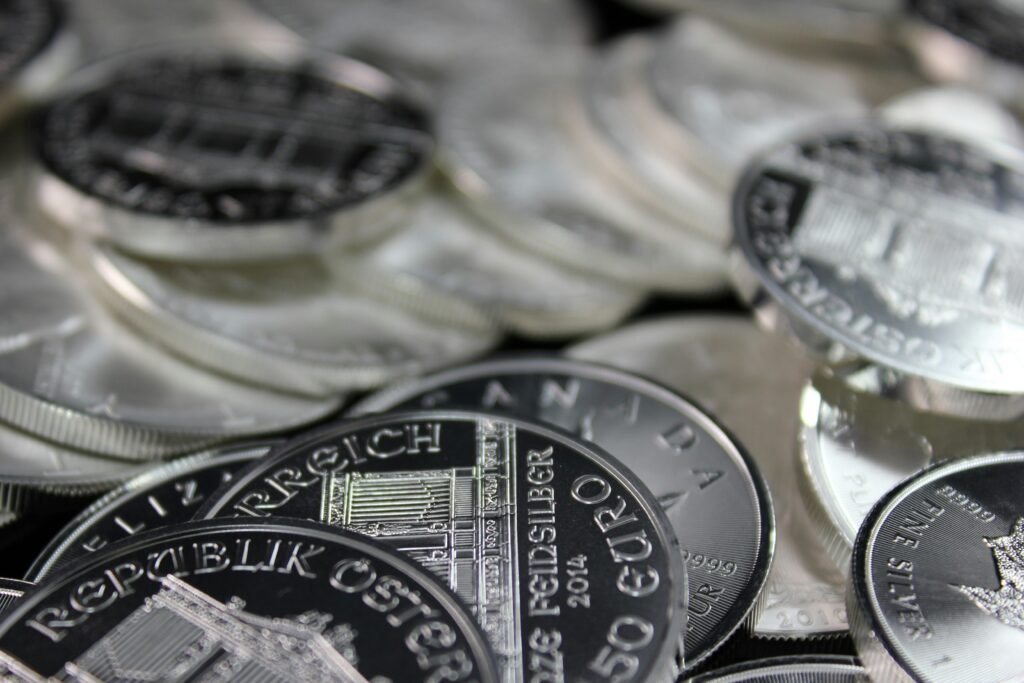
Where to start: Physical silver coins or gold in fractional amounts through regulated bullion dealers. Even a small consistent position builds meaningful protection over years.
5. Cryptocurrency — The Experimental Asset Wealthy People Actually Own at Measured Allocations
Bitcoin was not created as speculation. It was created in 2008 as a direct response to governments’ ability to print money, devalue savings, and transfer the consequences to ordinary people. Its hard supply cap of 21 million coins means no central authority can inflate it away — a property that matters more in economies with currency instability than in stable ones.
In countries where devaluation is a lived reality — not an academic risk — Bitcoin’s design is not theoretical. It is a documented alternative store of value for people whose local currency has failed them.
But the risks are real and rarely stated honestly:
- Volatility — Bitcoin has fallen 50–80% from peak prices multiple times. Anyone who needed that money during those periods lost it regardless of what happened afterwards.
- Custody — crypto held on an exchange is not truly owned. If the exchange collapses, the coins may be permanently gone. Self-custody through a hardware wallet is the only genuine ownership.
- Regulation — governments worldwide are still determining how to treat crypto. Policy changes directly affect accessibility and value.
The correct approach is a small allocation — specifically one you can treat as potentially zero without affecting your financial stability. Treat it as one experimental position within a diversified asset approach, not as a replacement for all other thinking.
Where to start: A regulated exchange in your country. Small allocation only, held long-term, with no emotional reaction to daily price movements.
6. Digital Products and Intellectual Property — The Asset Wealthy People Actually Own That Costs Almost Nothing to Start
This is the asset category most accessible to people starting with no capital — and the most absent from mainstream wealth discussions because it does not fit the traditional asset management conversation.
A digital product — a guide, a course, a template, software, a newsletter — can be created once and sold repeatedly without physical production costs. The economics are fundamentally different from trading time for money: one course can teach thousands of students, one guide can be purchased thousands of times, one tool can serve thousands of users across years without additional active hours.
This is the first realistic asset that earns beyond direct time for most people starting from zero. Not immediately. Not effortlessly. But the infrastructure for it costs nothing to begin, which makes it categorically different from every other asset on this list.
Where to start: Gumroad for digital products. Patreon for recurring membership revenue. Zero startup capital required — only knowledge you already possess and time to package it properly.

7. Skills, Reputation, and Audience — The Invisible Assets Wealthy People Actually Own
The most overlooked assets wealthy people actually own do not appear on any balance sheet.
A skill that reliably solves expensive problems is an asset. A reputation that makes people trust your judgment before they meet you is an asset. An audience that pays attention when you speak is an asset. These cannot be destroyed by a market crash, an employer’s decision, or a government’s monetary policy. They travel with you across industries, borders, and economic cycles.
They also amplify every other asset. The person with an audience sells digital products more easily. The person with a strong reputation raises capital on better terms. The person with rare skills negotiates equity rather than accepting salary.
These are the assets wealthy people actually own that compound most reliably with time — and cost the least to begin building today.
Where to start: One skill, practiced deliberately and publicly, for one consistent year. The reputation follows the demonstrated proof. The audience follows the reputation.
What Wealthy People Actually Own vs What Most People Own
| What Most People Own | What Wealthy People Actually Own |
|---|---|
| A salary that stops when they stop | Assets that generate income independently |
| A car that loses value from day one | Business equity that appreciates over time |
| Cash in a bank losing value to inflation | Gold, silver, and commodities as inflation protection |
| One currency exposed to one government’s policy | Assets denominated across multiple currencies and classes |
| Income tied entirely to active working hours | Digital products and IP that earn without active presence |
| Wealth dependent on employer’s continued goodwill | Skills and reputation no employer can take away |
| Crisis = immediate financial emergency | Crisis = one stream reduces, others continue |
| Nothing compounds after active work stops | Ownership compounds across decades independently |
How to Start Building What Wealthy People Actually Own From Nothing
The most common objection is capital. It is largely the wrong objection.
Someone earning $250,000 a year but carrying high debt and spending aggressively may have a lower net worth than someone earning far less who has saved and invested consistently for decades. Net worth, not income, is the better measure of long-term financial health.
The starting sequence that requires the least capital:
- Stage 1 — Build a skill and structure it as a business. This costs nothing except time. It is the fastest path from zero assets to one asset that earns beyond your direct hours.
- Stage 2 — Package that skill into a digital product. The freelance knowledge becomes a guide. The consulting process becomes a template. One active stream seeds one semi-passive one.
- Stage 3 — Add a small consistent equity position. A broad-market index fund with a fixed monthly contribution regardless of market conditions. Time in the market matters more than timing the market.
- Stage 4 — Add a physical protection position. A small silver or gold holding as a hedge against currency instability. Particularly relevant for anyone in an economy with a history of devaluation.
- Stage 5 — Build the audience. Every asset on this list becomes more valuable when you have people paying attention to what you do. An audience amplifies every other asset simultaneously.
Frequently Asked Questions: What Do Wealthy People Actually Own
Q: What do wealthy people actually own most of at the very top levels?
At the highest wealth levels, private business equity dominates. Only at the very top of the wealth distribution does business equity outweigh real estate as the primary asset. Below that level, real estate is the largest single asset category across most of the wealth distribution.
Q: Do wealthy people actually own a lot of cash?
More than most people expect — but for a specific reason. Wealthy people hold cash not as a store of value but as a tool for opportunistic action. The rich often capitalize on market dislocations, buying undervalued assets during downturns — which requires liquid cash available precisely when everyone else is selling.
Q: Can someone with almost no money start building what wealthy people actually own?
Yes — and digital products, skills, and equity index funds are the three most accessible starting points. None of these require significant capital. All of them require consistent time and deliberate practice before they produce meaningful returns.
Q: Why do wealthy people own so much of the stock market specifically?
Because equities compound over time in a way that most other assets do not, and wealthy people have both the time horizon and the financial stability to hold through downturns without selling. The top 20% has more than 10 times as much wealth in stocks and mutual funds as the next 20% income group. The gap is not explained by intelligence — it is explained by starting earlier and holding longer.
Q: Is cryptocurrency something wealthy people actually own seriously?
At measured allocations — yes, particularly among younger wealthy individuals. While stocks and bonds fell 10–15% or more in early 2025, the richest Americans relied on diversified portfolios including real estate, private businesses, cryptocurrencies, private equity, and alternative investments not correlated with stocks. Crypto functions as one diversification component — not a primary wealth vehicle.
Q: What is the single most important shift in thinking about what wealthy people actually own?
Stopping the question “how much did I earn this month” and replacing it with “what did I add to what I own this year.” That shift — from income thinking to ownership thinking — is the foundational change that separates wealth builders from everyone else.
Conclusion
What wealthy people actually own is not a mystery — it is documented, verifiable, and far more accessible than most people assume. Businesses. Equities. Real estate. Protective metals. Digital products. Skills and reputation that no market can erase. The gap between the wealthy and everyone else is not primarily an income gap. It is an ownership gap. And ownership, unlike income, can begin at any level — with almost any starting amount — if the decision to start is made before the need becomes urgent.