



You have opinions. Strong ones. About politics. About success. About what works and what doesn’t. About who is right and who is wrong. But here is the question nobody asks:
Where did those opinions come from?
Not in a philosophical sense. Practically. Trace one opinion you hold strongly right now back to its origin. Did you arrive at it through your own observation and reasoning? Or did you consume it — a reel, a podcast, a creator you trust, a comment section you spent too long in?
If you are honest — most of what you believe was handed to you.
And you accepted it because it felt right. Because it matched something you already half believed. Because the person delivering it was confident. Because everyone around you seemed to agree.
That is not thinking. That is receiving.
Learning how to think for yourself is not a philosophical luxury. In a world where every platform is designed to colonize your attention and shape your beliefs — it is a survival skill.
If you have not read [Blog #1 — Welcome to the Edge] yet — start there. Understanding why the world is genuinely unstable makes this blog land differently.
The Question Nobody Asks About Their Own Opinions
Paul Graham wrote a brilliant essay on independent thinking in 2020. Philosophers from Schopenhauer to Descartes debated it for centuries. Scott Young wrote about it practically in 2021.
None of them wrote for the person in Lahore, Lagos or Jakarta in 2026 — where the algorithm is more aggressive, the information environment is more controlled, the social cost of dissent is higher, and the consequences of borrowed thinking are not just intellectual but financial, physical and political.
This is that version.
What the Algorithm Is Actually Doing to You

Every platform you use has one job — keep you on it as long as possible. To do that it studies you. What you pause on. What you rewatch. What makes you angry enough to comment. What makes you feel smart enough to share. Then it feeds you more of exactly that.
Not because it is true. Not because it is balanced. Because it keeps you engaged.
Over time your feed becomes a mirror — reflecting your existing beliefs back at you, amplified and confirmed, surrounded by people who agree. This is called a filter bubble. And most people live inside one without knowing it. The result is not just that you see limited information. It is that you start to believe your limited view is the complete picture.
This is the static. The constant noise designed to sound like signal. Most people never learn to tell the difference. You feel informed. You are managed.
Three things the algorithm does that most people never notice:
- It removes friction deliberately. Every piece of content that challenges your existing beliefs creates friction — you hesitate, you scroll away. The algorithm learns this and stops showing you challenge. Over time your feed becomes frictionless. Frictionless means confirmation only.
- It makes outrage addictive. Content that makes you angry produces the same chemical response as physical reward. The algorithm knows this. It shows you more of what made you angry yesterday.
- It manufactures consensus. When everyone in your feed agrees on something — you experience that as evidence. It is not evidence. It is the algorithm showing the same content to people it has already identified as likely to agree.
What Borrowed Thinking Actually Costs You
It costs you more than you realize.When your opinions are borrowed you cannot defend them under pressure. The moment someone challenges you with a perspective you have not consumed yet — you either shut down or get angry. Neither is thinking.
When your worldview is algorithm-shaped you make decisions based on incomplete information presented as complete truth. Business decisions. Life decisions. Relationship decisions. All filtered through a lens someone else built for you.
And when everyone around you is consuming the same feeds, agreeing with the same creators, repeating the same arguments — you mistake consensus for correctness.
History is full of moments where the consensus was catastrophically wrong.
The people who saw differently — who questioned what everyone around them accepted — were not contrarians for the sake of it. They were thinkers. And thinking is what separated them.
Consuming vs Thinking — The Real Difference
Consuming is passive. Information enters. You react. You agree or disagree based on feeling. You move to the next piece of content.
Thinking is active. Information enters. You question its source. You look for what contradicts it. You sit with the discomfort of not having an immediate answer. You form a position slowly — and you hold it loosely enough to change it when better information arrives.
Most people never learned the difference because school did not teach it. School taught you to find the right answer. Thinking teaches you to question whether you are asking the right question.
Here is the comparison most people never see:
| Consuming | Thinking |
|---|---|
| Passive — information enters, you react | Active — information enters, you interrogate it |
| Agree or disagree based on feeling | Form a position based on evidence and contradiction |
| Move to the next piece of content | Sit with the discomfort of not having an immediate answer |
| Hold opinions rigidly | Hold positions loosely enough to change when better information arrives |
| Asks: “Do I agree with this?” | Asks: “Where does this come from and what does it contradict?” |
| Shaped by algorithm | Shaped by deliberate input |
| Rewarded socially — agreement, likes | Often socially costly |
5 Ways to Train How to Think for Yourself
Not by watching more content about it. By doing uncomfortable things deliberately.
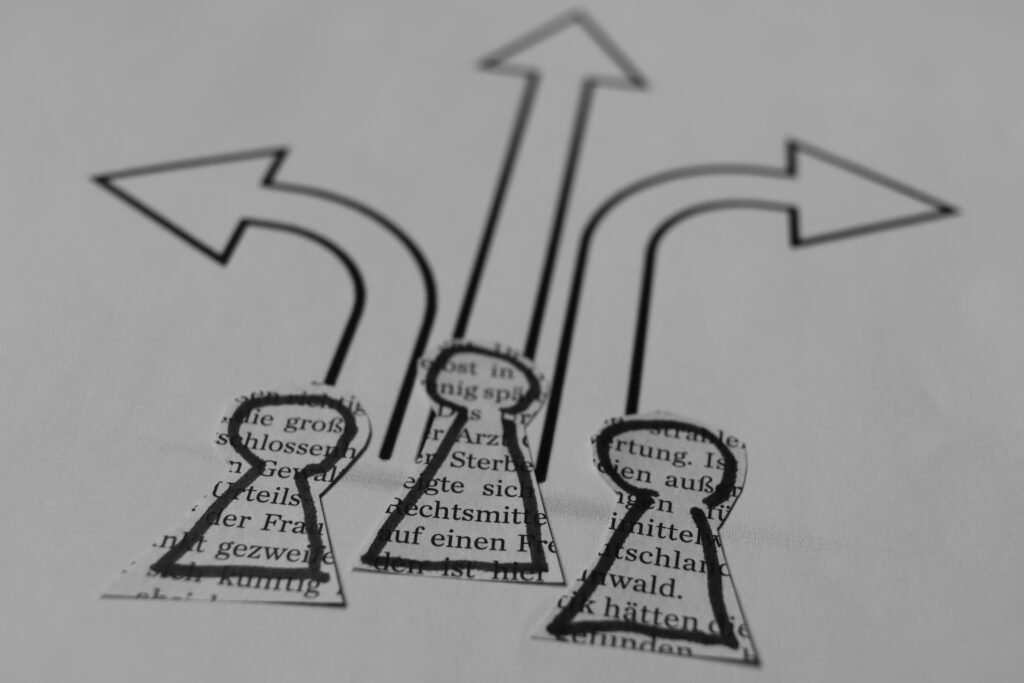
1. Trace your opinions.
Pick one strong belief you hold. Spend ten minutes tracing where it came from. Was it your own experience or someone else’s conclusion? You do not have to change the opinion — just know where it actually came from.Most people who do this honestly are surprised. The opinions that feel most personally held are often the most directly borrowed.
2. Consume the opposite deliberately.
Whatever your algorithm feeds you — find the strongest opposing argument. Not to agree with it. To understand it well enough to argue it yourself. An opinion you cannot argue against is not a position. It is a preference.
3. Sit with unanswered questions.
Most people rush to resolution — they need to know what to think before they close the tab. Practice staying with a question you cannot answer yet. Write it down. Return to it over days. Uncertainty is not weakness. It is the beginning of real thinking.
4. Talk to people your algorithm would never show you.
Someone from a completely different background, belief system, economic reality. Not to debate. To understand how the world looks from somewhere else entirely. Your worldview expands every time you genuinely listen to someone outside it.
5. Create before you consume.
Before you open any platform in the morning — write one thought. Your own. About anything. What you noticed yesterday. What you are uncertain about. What you observed. Creating first protects your thinking from being immediately colonized by someone else’s.
The Hidden Cost Nobody Warns You About
Independent thinking is not free.It costs social capital. And in some environments — tight family structures, close communities, tribal societies where consensus is survival — it costs more than most self-help books will ever acknowledge.
When you start questioning what everyone around you accepts — the education system, the financial system, the political narrative, the cultural expectations — you create friction. Not because you are wrong. But because consensus is socially load-bearing. The community that agrees on things holds together. The person who stops agreeing becomes — in some measure — a threat to that holding together.
This is not an excuse to stop thinking. It is an honest map of the terrain.
Subversive Independence — The Strategy
The practical response is not loud rebellion.
It is subversive independence — building your edge, your thinking, your capability quietly. Maintaining the social interface your environment requires while doing the real work in private. Not performing compliance you do not feel — but choosing carefully which battles to fight publicly and which growth to pursue silently.
The blog you read privately. The skill you build without announcing it. The question you sit with alone before deciding whether to voice it. The financial preparation you make before anyone around you thinks it is necessary.
This is not weakness. It is strategy.
The person who burns their social capital fighting every battle publicly often ends up isolated before they have built anything worth defending. The person who builds quietly reaches a point where the independence becomes visible through results rather than arguments.
Build first. The visibility takes care of itself.
How to Think for Yourself vs What Philosophers Say: Comparison Table
| What Philosophers Say | What NexCurian Says Instead | Why the Difference Matters |
|---|---|---|
| Read widely and think about what you read (Schopenhauer, Scott Young) | Create before you consume — protect your thinking before it forms | In algorithmic environments, consumption colonizes before you notice |
| Be curious and resist conformity (Paul Graham) | Understand the cost of non-conformity in your specific social context | Paul Graham writes for Silicon Valley founders. Your social cost may be significantly higher |
| Think for yourself as an intellectual virtue (Aeon/Psyche) | Think for yourself as a survival architecture | Academic framing makes it optional. NexCurian makes it urgent |
| Surround yourself with independent-minded people | Build information sovereignty offline so your thinking survives when the network is cut | No philosophical guide accounts for state-controlled internet shutdowns |
| Question conventional wisdom | Trace every opinion you hold to its origin — especially your “independent” ones | The opinions that feel most personal are often the most directly borrowed |
| Written for educated western readers with stable information access | Written for people where information can be switched off by a government order | The stakes are different. The tools need to be different too |
 Information Sovereignty — Your Knowledge Must Be Offline Too
Information sovereignty is not just a mindset. It is a hard drive.
When the internet goes down — your ability to think independently depends on having information that does not require connectivity.
State actors have shut down the internet during protests, elections and civil unrest. This is documented and recurring. The person whose entire knowledge base lives online has knowledge that can be switched off with a single government order.
Kiwix — a free application — allows you to download entire offline versions of Wikipedia, Khan Academy, medical references, survival manuals and educational libraries. Stored locally. Accessible without internet. Forever.
| Information Source | Online Only | Offline Accessible |
|---|---|---|
| Wikipedia | ✓ vulnerable to shutdown | ✓ via Kiwix download |
| Khan Academy | ✓ vulnerable to shutdown | ✓ via Kiwix download |
| Medical references | ✓ vulnerable to shutdown | ✓ via Kiwix download |
| Your own written notes | Partly | ✓ local storage or physical |
| Physical books and printed guides | ✗ | ✓ permanently |
| Skills practiced and embodied | ✗ | ✓ permanently |
Printed manuals. Downloaded guides. Physical books.
The person who has diversified their information sources across online and offline — who can function intellectually when the network goes dark — has a form of independence that the purely connected person does not.
Download what matters to you. Own it physically. Your information sovereignty starts with what you can access when someone else decides to turn the signal off.
For a deeper look at how your data is already being used against your thinking — read [Blog #17 — You Are the Product].
Why This Is the Foundation of Everything Else
Every other skill in this series — negotiation, selling, cross-domain thinking, building what does not exist — requires you to think clearly and independently.
- You cannot negotiate well if your read of the situation is borrowed.
- You cannot sell genuinely if you do not understand what you actually believe.
- You cannot build what does not exist if your imagination is limited to what your feed has already shown you.
Independent thinking is not one skill among many. It is the ground everything else is built on.
And right now — while everyone else is downloading the next tool, following the next trend, borrowing the next opinion — it is one of the rarest things a person can develop.
What Other Guides on This Topic Won’t Tell You
Paul Graham’s essay is brilliant. Scott Young’s is practical. The Aeon/Psyche piece is philosophically rich. None of them tell you what happens when thinking for yourself has a real cost in your specific environment. None of them account for algorithmically manufactured consensus. None of them address internet shutdowns as a threat to intellectual independence. None of them connect independent thinking to financial resilience, physical preparation or survival architecture.
They treat thinking for yourself as a virtue. NexCurian treats it as infrastructure.
| What Other Guides Say | What NexCurian Says Instead |
|---|---|
| Read widely and think for yourself | Create before you consume — or the algorithm colonizes your thinking first |
| Surround yourself with independent thinkers | Build offline information sovereignty — independent thought needs independent access |
| Question conventional wisdom | Question your own “independent” opinions first — they are the most borrowed |
| Independent thinking is an intellectual virtue | Independent thinking is survival infrastructure in an algorithmically managed world |
| Written for stable western information environments | Written for people where the internet gets switched off and consensus has real consequences |
If this changed how you see your own feed — send it to one person whose thinking you want to protect.
Conclusion
The practice is simple. The discipline is rare.
Learn how to think for yourself. Not because everyone else is wrong. Because you owe it to yourself to find out what you actually believe — separate from what you have been shown, sold and handed.
Trace your opinions. Consume the opposition. Sit with uncertainty. Create before you consume. Build your knowledge offline.
That clarity — developed deliberately, protected fiercely — is an edge most people will never have. Not because it is inaccessible.
Because the algorithm makes receiving easier than thinking every single day.
That is not philosophy. That is survival.
→ Read next: [Blog #5 — The Room Where Everything Changes]*
→ Related: [Blog #17 — You Are the Product]*
→ Related: [Blog #16 — The Quiet Architecture of Control]*
FAQs
1. What does it actually mean to think for yourself?
It means tracing your beliefs to their origin, seeking contradicting evidence deliberately, and forming positions through your own reasoning rather than absorbing someone else’s conclusion. It starts with one exercise: pick any strong opinion you hold and spend ten minutes figuring out where it actually came from.
2. Why is thinking for yourself so hard in 2026?
Because every platform you use is engineered to prevent it. Algorithmic feeds create filter bubbles that reflect your existing beliefs back amplified. Outrage mechanics make emotional reactions more rewarding than reasoned ones. Manufactured consensus makes borrowed thinking feel like independent agreement. These are not accidental features. They are the business model.
3. How is NexCurian’s approach different from Paul Graham or Scott Young?
Paul Graham writes for founders where the cost of non-conformity is social friction. Scott Young writes for self-improvers with reliable information access. NexCurian writes for people where the cost of non-conformity can be family rupture or political consequence — and where the internet can be switched off by a government order. The framework is the same. The stakes and tools are different.
4. What is information sovereignty?
It means owning knowledge that does not depend on connectivity, platform permission or government tolerance. When the internet goes down — and it has gone down deliberately in Pakistan, Iran, Nigeria, Myanmar and other countries — the person whose entire knowledge base is online loses access to their own thinking tools. Downloading offline information through Kiwix is a practical first step.
5. What is subversive independence?
It is the practice of building genuine capability and independent thinking privately — without performing rebellion in contexts where the social cost is too high. Choose which battles to fight publicly and which growth to pursue silently. It is not cowardice. It is the strategic recognition that building quietly until results make the argument is more effective than arguing before you have built anything.
6. What is the main difference between independent-minded and conventional-minded thinking?
Independent-minded thinkers form beliefs through personal reasoning and are comfortable — even energized — by views that contradict consensus. Conventional-minded thinkers align their beliefs with their social group’s consensus, often without realizing it. The core difference is not intelligence but the *source* of belief formation.
7. Is conventional-minded thinking always inferior?
No. In most roles — administration, operations, mid-level management, military service — conventional-minded thinking is not only sufficient but often superior. The problem arises only when a conventionally-minded person pursues a field that intrinsically requires novelty, or vice versa.
8. How do I know which type of thinker I am?
Self-assessment is unreliable because conventional-minded people consistently misidentify themselves as independent. A better test: state your actual views publicly on contested topics. If the reaction surprises you — if people find your views more unusual than you expected — that’s evidence of independent-mindedness. If your views consistently land as moderate and uncontroversial, that’s data too.
9. What is “intellectual fashion” and why does it matter?
Intellectual fashion is the spread of ideas through social groups based on their social currency rather than their truth-value. It matters because it can masquerade as reasoning. Many people believe they are thinking independently when they are simply following the intellectual trends of their peer group. The antidote is to actively seek unfashionable ideas in your field — they are statistically more likely to contain overlooked truth.
10. Where do I start?
Start with Practice 5 — create before you consume. Before you open any platform tomorrow morning, write one thought. Your own. Five minutes. It changes the direction your mind operates for the rest of the day. Add one more practice each week. The compounding effect becomes visible within a month.
Part of The 2050 Blueprint: Build, Earn and Endure — a survival intelligence series.




[…] → Read next: [Reading the Static: How to Think for Yourself in a World Designed to Think for You] […]
[…] of the 2050 Blueprint: Build, Earn and […]